
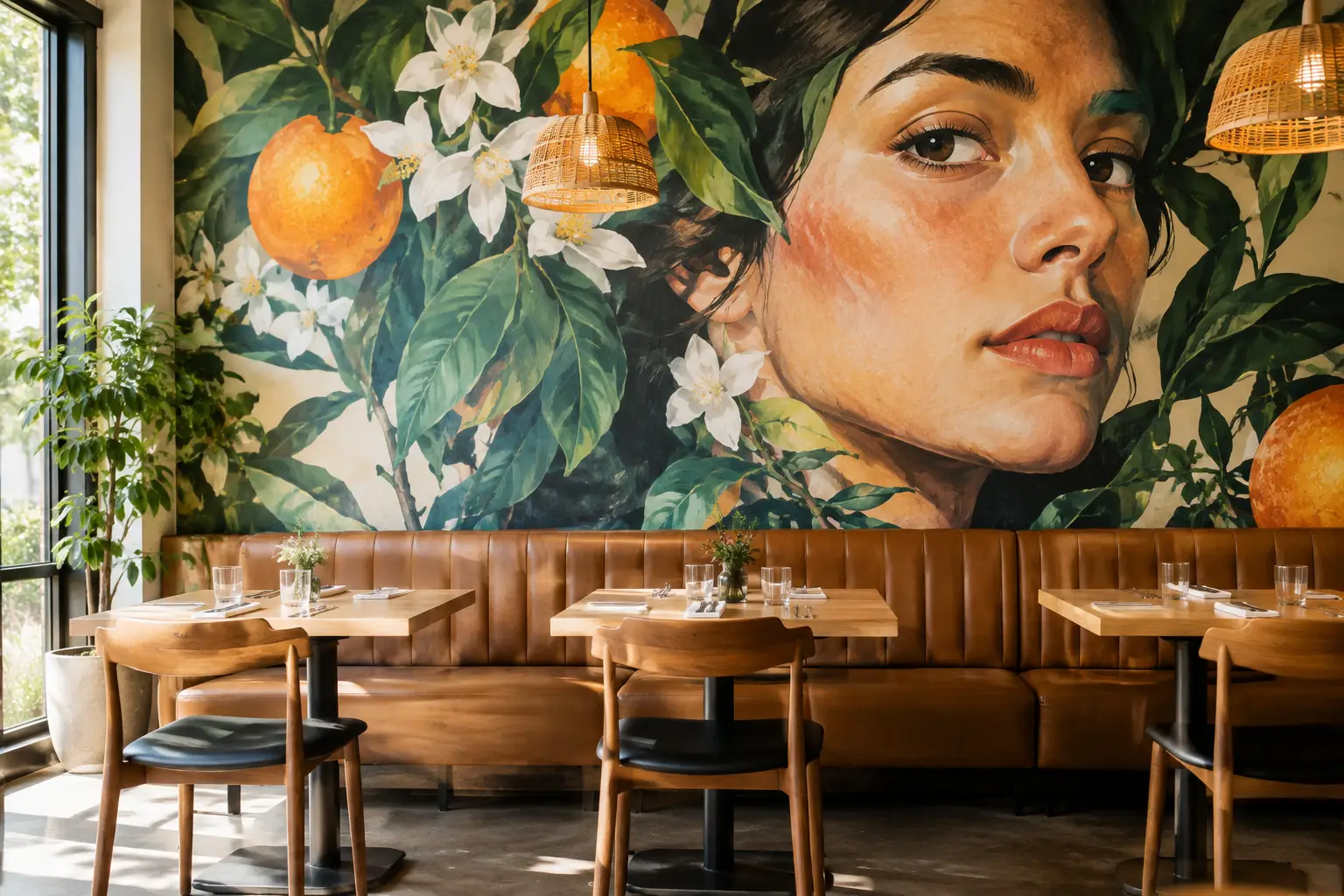
A restaurant wall has only a few seconds to say something before a guest looks back at the menu, checks their phone, or settles into conversation. The right restaurant murals give that moment a purpose. They can make a narrow dining room feel expansive, reinforce a chef’s point of view, create a natural photo backdrop, or bring warmth to a space that otherwise relies on hard surfaces and practical lighting.
But a mural is not simply oversized art. In a commercial setting, it has to work around tables, traffic, lighting, cleaning routines, and the shifting visual demands of day and night service. A dramatic image that looks excellent on a screen can feel too busy behind a row of banquettes. A subtle landscape may be beautiful, but disappear under low evening light. Good results come from treating the wall as part of the guest experience, not as an empty surface to fill.
Start With the Feeling You Want Guests to Remember
Before selecting a theme, identify the mood the restaurant should create. A coastal seafood spot may call for misty shorelines, waves, weathered maps, or abstract water-inspired forms. A neighborhood café might feel more inviting with botanical artwork, hand-drawn city details, or a warm-toned custom photograph. A cocktail bar may benefit from high-contrast florals, a moody forest scene, or a graphic pattern that carries the room after dark.
The mural does not need to literally illustrate the menu. In fact, food photography and obvious theme decor can sometimes make a room feel dated or overly staged. Look for imagery that supports the restaurant’s personality more indirectly. A Mediterranean concept might use sun-faded architecture and olive branches rather than a wall-sized plate of pasta. A modern ramen shop could use ink-style waves, abstract linework, or a night-city scene that suggests energy without becoming a costume.
Color is equally important. Pull one or two tones from existing upholstery, tile, wood finishes, menus, or signage, then let the mural add depth around them. If the room already has patterned flooring, colorful chairs, and open shelving, a quieter image with a strong sense of texture may balance the space better than another high-detail pattern.
Choose Restaurant Murals for the Actual Wall
A mural should be chosen at the size it will live, not at thumbnail size. Scale changes everything. A small floral image may become immersive when enlarged across a 20-foot wall, while a tightly cropped image can turn awkward once it is interrupted by chair rails, pendant lights, or a service station.
Measure the full printable area, including the height above baseboards and below ceiling details. Then map permanent interruptions: electrical outlets, thermostat controls, wall sconces, door frames, shelving, and built-in seating. These elements are not necessarily a reason to abandon the mural. They simply need to be accounted for before the artwork is cropped and printed.
A few placement decisions tend to matter most:
- A focal wall behind host seating or along a main dining area can establish the visual identity of the room.
- A long wall beside banquettes benefits from imagery with horizontal movement, such as a landscape, skyline, forest, or repeating pattern.
- A smaller wall near restrooms or a hallway can handle bolder color, playful illustration, or a more unexpected visual moment.
- A wall visible from the street should be designed for both daytime readability and nighttime ambiance.
For a restaurant with low ceilings, use imagery with vertical lift: tall trees, architectural facades, open sky, or upward-moving abstract forms. In a deep but narrow space, a receding road, beach horizon, mountain view, or city scene can create a greater sense of depth. These are visual tools, not rules. A dark mural can make a room feel intimate and intentional when the lighting and furnishings support it.
Think About Viewing Distance
Guests rarely stand directly in front of a restaurant mural for long. They see it while walking in, from across the dining room, or from a seated position. That is why images with a clear overall composition usually perform better than artwork that depends on tiny details.
A high-resolution close-up of a flower, for example, can feel lush and sophisticated from several feet away. A crowded collage of small objects may only read as visual noise. If an image includes faces, typography, or a recognizable local landmark, make sure the important area will not be hidden behind booths, table lamps, or guests themselves.
Use Custom Artwork Without Risking Print Quality
Custom photography gives restaurant owners a chance to tell a story nobody else can copy. It might be a local shoreline, a historic neighborhood image, a photograph from the owner’s travels, original illustration, or artwork created specifically for the brand. It can also be a practical way to extend existing identity elements into the interior.
The trade-off is image quality. A phone photo that looks crisp on social media may not have enough resolution for a room-scale print. Enlarging a low-quality file can produce softness, pixelation, or visible compression artifacts. Cropping also matters. A wide image may be ideal for a long wall but unsuitable for a tall, narrow section without losing its focal point.
This is where design review is valuable. At Murale Design, custom-image projects can be evaluated before production so the artwork, dimensions, and crop are appropriate for the intended wall. That guidance is especially useful when a mural must align with millwork, cover a large area, or coordinate across multiple locations.
For a more flexible starting point, themed artwork can be customized to the wall dimensions while avoiding the uncertainty of a personal image file. Forests, florals, beaches, cityscapes, maps, animals, and abstract designs each create a distinct atmosphere, but they also offer enough range to suit casual and elevated dining concepts alike.
Specify a Material Built for Daily Restaurant Life
Restaurants are tough environments. Walls near tables are exposed to bags, chair backs, cleaning, fingerprints, and constant movement. Areas near a bar, beverage station, or open kitchen can also contend with humidity, splashes, and more frequent wiping. The material should look polished, but it also needs to be practical.
Adhesive vinyl mural wallpaper is a strong option for painted drywall because it creates a continuous, tailored look without the framing and spacing constraints of traditional art. A scratch-resistant finish helps the surface hold up better in high-touch areas, while latex inks provide durable color for interior applications.
Wall condition matters as much as material. The surface should be clean, dry, smooth, and fully cured if recently painted. Fresh paint can release moisture or contain additives that interfere with adhesion, so allow appropriate curing time before installation. Heavy texture, flaking paint, grease residue, and uneven patches can show through or reduce the mural’s ability to bond correctly.
In dining rooms with active service, plan installation during a closed period whenever possible. Large mural panels need room to be positioned accurately, and installers need clear access to the wall. Protecting nearby furniture and confirming panel order before starting will reduce stress when the schedule is tight.
Let Lighting and Operations Shape the Final Choice
A mural that looks balanced in morning sunlight may shift dramatically under warm dimmers at dinner. Requesting a sample or reviewing colors alongside finish swatches can prevent surprises. Very dark imagery can become muddy under low light, while bright white backgrounds may create glare near reflective tabletops or windows.
Operational details deserve the same attention. Consider where staff will lean, where high chairs may scrape, and where guests tend to wait. If a wall is likely to be photographed, leave enough open visual space around the main focal point so the mural still reads well with people in front of it. If branded messaging is included, keep it restrained. Guests should feel they are in a considered environment, not standing inside an advertisement.
The most successful restaurant murals do more than fill a wall. They give guests a reason to pause, help the room feel unmistakably its own, and continue working long after the first busy service.
