
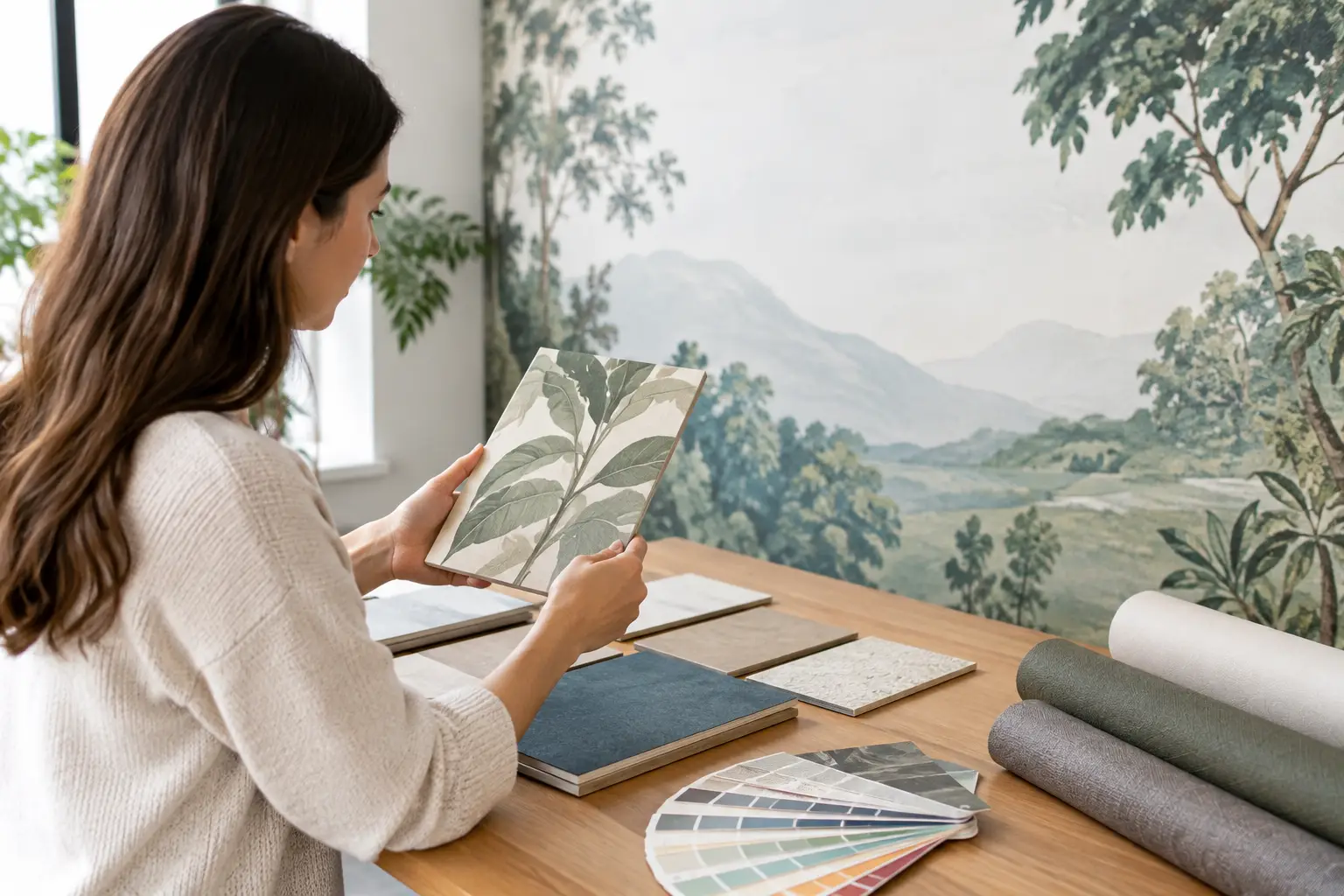
A mural can make a small bedroom feel like a retreat, give a reception area a stronger point of view, or turn a plain nursery wall into the most memorable part of the room. But the image is only half the decision. This guide to choosing mural material starts with the surface behind the artwork, because the right material has to look beautiful and perform well on the wall you actually have.
A misty forest, oversized florals, a city skyline, or a personal photograph may all suit the same room visually. Their success over time depends on practical details: wall texture, light exposure, traffic, installation conditions, and whether the mural needs to cover one focused feature wall or a large multi-panel expanse. Choosing with those details in mind makes a custom project feel far more manageable.
Start With the Room, Not Just the Design
Before comparing materials, consider how the room is used. A low-traffic guest bedroom gives you more flexibility than a busy retail corridor, a family playroom, or an office entrance where walls are frequently brushed by bags, chairs, and hands. The more visible and active the space, the more valuable a durable, easy-to-clean surface becomes.
Light matters too. A wall opposite large windows can make a mural feel brighter and more open, but direct sunlight may also reveal glare on some finishes. Dark, dramatic artwork can create depth in a well-lit living room, while a lighter design may be the better choice for a hallway with limited natural light. Material and finish should support the mood you want at every time of day, not only in a product preview.
Finally, decide whether you are creating a wall mural or simply adding wall art. A mural is designed around the dimensions of the wall and becomes part of the room’s architecture. A canvas print or tapestry is a strong decorative option when you want an image to remain visually contained, preserve exposed wall space, or avoid covering a textured or difficult surface.
A Guide to Choosing Mural Material
For many interior mural projects, adhesive vinyl wall film is a practical choice because it combines a wallpaper-scale visual with a clean, modern application method. It is especially well suited to properly prepared painted drywall, which is the most common surface in homes, apartments, offices, and client-facing commercial interiors.
Adhesive vinyl wall murals
Adhesive vinyl is made for image-rich, custom-sized wall coverage. It can reproduce fine details in photography, subtle tonal changes in watercolor artwork, and saturated color in graphic patterns. Because the mural is produced to the dimensions of the installation area, it avoids the compromise of trying to make a standard-size print work on a nonstandard wall.
For a feature wall, custom adhesive vinyl also gives you meaningful control over the composition. A designer can position a horizon line, a face, a botanical focal point, or a map label where it will make sense around furniture, doors, outlets, and windows. This is particularly helpful when working with a customer-supplied image rather than a repeating wallpaper pattern.
At Murale Design, murals are printed on adhesive vinyl film with durable latex inks and an anti-scratch finish. That combination is a sensible fit for painted drywall installations where a polished look and everyday durability are both priorities. It also keeps the material choice straightforward for customers who want a made-to-order mural without managing paste, soaking, or complicated wallcovering tools.
Traditional pasted wallpaper
Traditional wallpaper remains a valid option for projects that call for a specific paper, fabric, embossed texture, or historic wallcovering look. It can be a good fit for formal spaces and for designs intended to repeat across several walls. However, its installation process is more involved, and the result depends heavily on proper adhesive selection, wall preparation, pattern matching, and installer experience.
For a single large photographic scene or custom artwork, pasted wallpaper may introduce more complexity than necessary. A mural based on one continuous image needs accurate panel alignment regardless of material, but adhesive vinyl removes the added variables of paste coverage and drying time. If your priority is a smooth, contemporary image wall on painted drywall, vinyl is generally the more direct route.
Canvas prints and tapestries
Canvas and tapestry materials serve a different purpose from wallcoverings. They are ideal when you want softness, texture, or a more traditional art-object feel. A large canvas print can bring a personal photo or abstract design into a room without committing to full-wall coverage. A tapestry can add warmth to a bedroom, dorm-style space, or creative studio where a textile effect suits the décor.
The trade-off is scale and integration. Neither option will give you the edge-to-edge architectural effect of a mural, and both leave the surrounding wall visible. Choose them when the image should read as artwork on the wall rather than as an immersive part of the room.
Match the Finish to Everyday Use
A mural finish should support the room rather than compete with it. In bright spaces, a lower-reflective surface can help the image remain comfortable to view from different angles. In a darker room, the same finish can preserve the depth of a black-and-white cityscape or the layered shadows of a forest scene without creating distracting hotspots.
Durability is not only about major impacts. It is about the small contacts that happen over years of use: a shoulder passing in a narrow hall, children playing near a wall, or furniture being moved during a room refresh. An anti-scratch finish is particularly useful for active rooms and commercial spaces, though no decorative wall surface should be treated as indestructible. Placement still matters. If the wall sits directly behind dining chairs or beside a constantly opening door, consider how the mural will be protected from repeated friction.
Let Wall Condition Make the Call
Even excellent mural material cannot overcome a poorly prepared surface. Painted drywall should be clean, dry, smooth, and fully cured before installation. Dust, kitchen residue, loose paint, and moisture can interfere with adhesion. Fresh paint deserves extra attention, since it needs adequate time to cure according to the paint manufacturer’s guidance.
Texture is the other major consideration. Light, subtle texture may be workable, but heavy orange peel, knockdown texture, brick, and uneven plaster can prevent a mural from making full contact with the wall. Those irregularities may show through the image or reduce long-term adhesion. In those cases, smoothing and priming the wall first is often the best investment in the finished result.
Do not overlook the wall’s geometry. Measure its height and width in several places, particularly in older homes where ceilings and corners may not be perfectly square. Note baseboards, crown molding, windows, doors, outlets, vents, and built-in shelving. Accurate measurements allow the mural to be sized correctly and help determine where panel seams will fall.
Choose an Image That Suits the Material and Scale
Large-format printing asks more of an image than a phone or laptop screen does. A photo that looks sharp at a small size can become soft or pixelated when enlarged across an eight-foot wall. This is not a material flaw. It is a resolution issue, and it is best addressed before production.
For personal photos, start with the largest original file available. Avoid screenshots, images saved repeatedly through social media, or heavily compressed files. If the image includes a person, pet, skyline, or landscape focal point, think about where that element will land after furniture is in place. A beautiful face should not disappear behind a headboard, and a mountain peak should not be cut by the top of a bookcase.
Design review is especially valuable for custom projects. A knowledgeable print team can assess image quality, recommend cropping choices, and flag potential concerns before the mural is produced. That support matters because a custom mural is not simply a print purchase. It is a room-scale composition.
Plan for Panels and Installation Day
Most large murals are produced in panels so they can be shipped, handled, and aligned on the wall. Panel construction is normal and should be expected, not feared. The key is careful installation: a clean starting line, gradual application, and attention to alignment as each panel meets the next.
Prepare the room before the mural arrives. Move furniture away from the wall, clean the surface, and give yourself clear floor space for handling panels. If the installation is especially large, positioned high on a wall, or located in a commercial setting with limited downtime, professional installation may be worth considering. It can be the difference between a good design idea and a finished wall that looks precisely as intended.
The best mural material is the one that supports your wall, your image, and the way the room is lived in. Once those three elements agree, the decision becomes less about choosing a product and more about giving a space a point of view that feels made for it.