
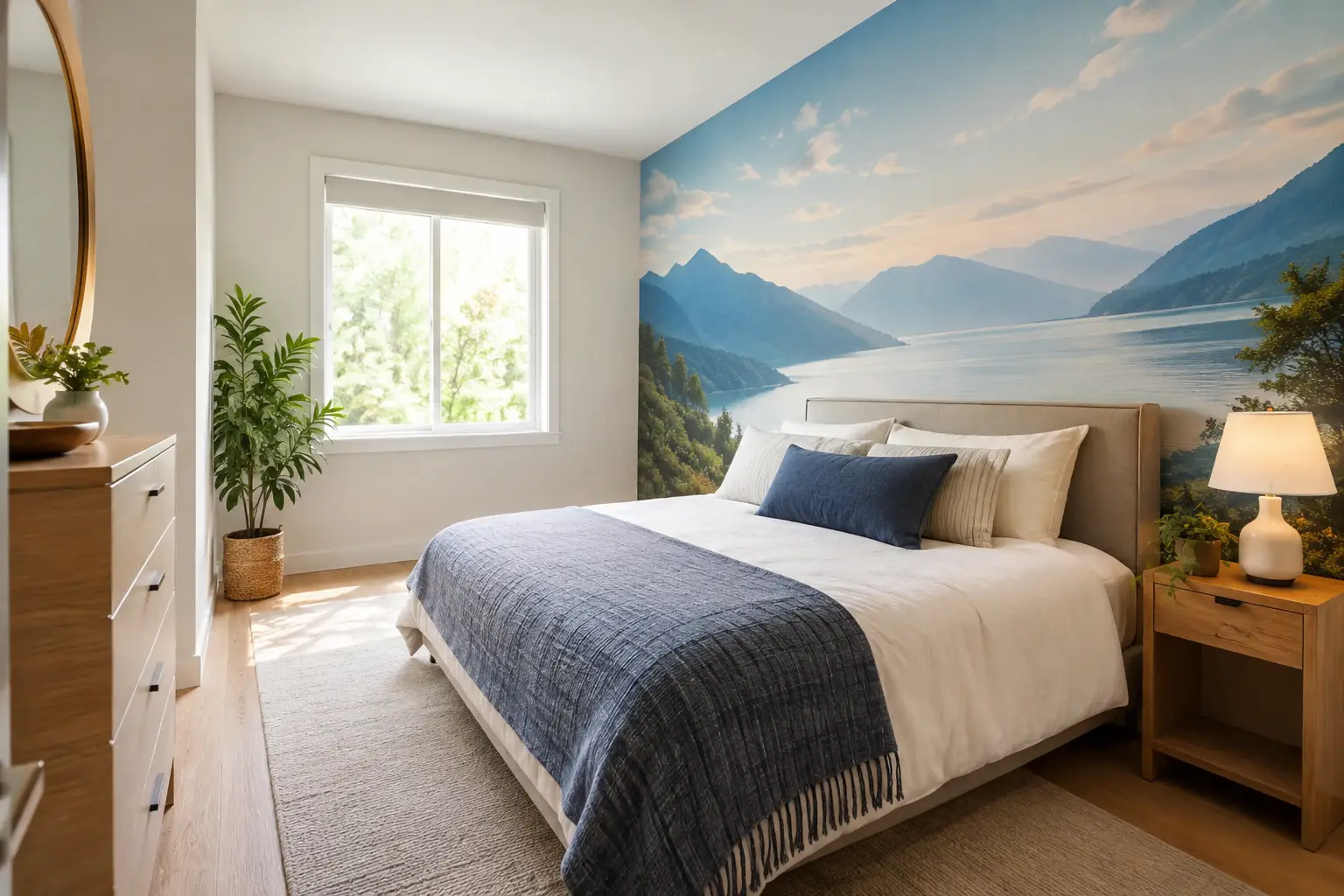
A small room does not need a small idea. The best murals for small rooms use one continuous image to create depth, establish a focal point, and give the eye somewhere farther to travel than the room’s four walls. A well-chosen mural can make a narrow bedroom feel calmer, a compact office feel more intentional, or a small nursery feel like its own little world.
The key is not simply choosing a light design. Scale, subject placement, viewing distance, natural light, and the wall itself all affect whether a mural opens up a room or makes it feel busier. Here is how to select artwork that brings visual space to a compact interior while still feeling personal.
What Makes a Mural Work in a Small Room?
A mural performs best in a small space when it creates a clear sense of perspective or a quiet visual field. Images with a horizon line, a pathway, soft layers of trees, distant water, mist, or an open sky suggest that the wall extends beyond its actual surface. This effect is especially useful on the wall you see first when entering the room or behind a bed, desk, or sofa.
Avoid treating every small room the same way. A windowless home office may benefit from a bright coastal view, while a bedroom used mainly at night can carry a deeper forest or moody floral design beautifully. The best choice depends on how the room is used and how much visual activity is already present in the furniture, textiles, and flooring.
Custom sizing matters as much as the artwork. A mural designed to fit the exact wall dimensions looks deliberate. It also allows the most important part of an image, such as the peak of a mountain, an animal, or a city skyline, to sit where it will not be covered by a headboard or shelving.
12 Best Murals for Small Rooms
1. Misty Forests with Depth
Forests work well when they include a visible trail, spaced tree trunks, or a pale foggy background. Those layers lead the eye into the design instead of stopping it at the wall. Choose softer greens, grays, and warm neutrals for bedrooms and reading corners. A dense, high-contrast forest can be striking, but it may feel enclosed in a room with limited daylight.
2. Coastal Horizons and Quiet Beaches
A beach mural with a low horizon is one of the most reliable ways to make a compact room feel wider. The open band of water and sky gives the composition breathing room, while sand tones coordinate easily with wood, linen, and white furnishings. Look for calm water or an uncrowded shoreline rather than a close-up wave, which can feel visually large and active.
3. Mountain Views with an Open Sky
Mountain murals offer depth without requiring a bright white palette. A distant range beneath a broad sky suits small bedrooms, entryways, and offices where you want a grounded, restful mood. Keep the tallest peak away from a corner whenever possible. Centering it behind a bed or desk often creates a strong focal point without making the wall feel crowded.
4. Soft Watercolor Florals
Florals do not have to be oversized and dramatic. Watercolor blooms, loosely painted stems, and faded botanical forms bring character to a smaller room while leaving visual space between details. This is a smart option for a guest bedroom, powder room, or dressing area where a scenic view may not suit the architecture.
The trade-off is contrast. Dark botanical backgrounds can create a cozy jewel-box effect, but they will not necessarily make the room feel larger. Choose them when atmosphere matters more than perceived square footage.
5. Pale Abstract Designs
Abstract murals are ideal when you want color and movement without a literal scene. Gentle washes, subtle arches, mineral textures, and layered neutral shapes can make a small room feel finished without dictating a specific decorating theme. They are also forgiving around doors, outlets, and furniture because the pattern does not depend on one precise focal point.
For the most open result, use designs with broad areas of negative space and no tight repeating pattern. Small, high-contrast motifs can read as clutter from across the room.
6. Cloudscapes and Open Skies
A soft cloud mural can raise the perceived ceiling in rooms that feel short or boxed in. It is particularly effective on the wall opposite a bed or in a small child’s room, where it adds imagination without overwhelming toys and colorful accessories. Keep the cloud scale natural. Extremely large clouds may feel closer rather than farther away.
7. Architectural Streets and City Views
Cityscape murals can add depth through streets, bridges, building lines, and vanishing points. They work best in a modern office, loft bedroom, or apartment living area with simple furnishings. Black-and-white or muted city imagery usually feels less busy than a highly saturated skyline at night.
Consider what the mural will be partially hidden by. If a sofa covers the lower third of the wall, choose a scene whose strongest perspective begins above that height.
8. World Maps with a Light Background
A world map gives a small office, study area, or child’s room a sense of scale and curiosity. Maps with a pale ground, fine linework, or watercolor landforms feel more spacious than dark, heavily detailed vintage maps. They are also practical for rooms that need personality but should remain flexible as a child grows or a workspace changes purpose.
9. Gentle Animal Illustrations
For nurseries and kids’ rooms, animal murals are most successful when the composition is airy. Woodland creatures set among open trees, safari animals on a light background, or ocean animals floating through a spacious blue field feel playful without overwhelming the room. Place the main characters where they can remain visible above a crib, dresser, or low bed.
10. Tropical Leaves with Space Between Them
Tropical murals can work in a small room, but the design needs restraint. Large leaves against a clean background create a bold feature wall while preserving a sense of openness. Dense jungle imagery is better for a powder room or a deliberately intimate nook than for a tight bedroom that needs to feel restful.
11. Desert Landscapes and Warm Neutrals
Desert scenes, dune forms, and sun-washed terrain bring warmth without visual noise. Their limited palette of sand, clay, blush, and muted gold can make a small room feel relaxed and cohesive, especially when paired with natural wood and soft textiles. Choose a design with distance in the landscape, not a close crop of rock or cactus.
12. A Personal Photo with Real Perspective
Your own travel photograph can become one of the best murals for small rooms if it has sufficient resolution and a strong composition. A photo of a lake, a trail, a favorite coastline, or an architectural view can make the room more personal than any catalog image. Not every phone photo is suitable for wall-scale printing, though. Images need sharp detail, balanced exposure, and enough pixel dimensions for the finished size.
Murale Design can review customer-supplied artwork before production, helping confirm whether an image will print clearly at the dimensions of your wall. That review is particularly valuable for a small room, where a soft or poorly cropped image will be noticeable up close.
Choose the Right Wall and Scale
In a compact room, one mural wall is usually enough. The wall behind a bed, sofa, or desk is often the most practical choice because the furniture anchors the mural and leaves other walls visually quiet. If the room has a narrow end wall, a landscape with a central path or horizon can make that wall feel farther away.
Measure the full wall, including areas behind furniture if the mural will be installed before the furniture is placed. Note windows, doors, outlets, vents, and trim. A made-to-order mural can be prepared for the wall’s dimensions, but the visual composition should still be planned around permanent features. A face, landmark, or key design detail should not land directly behind a tall cabinet.
Do not automatically choose the smallest-scale pattern for the smallest room. One large, calm image is often easier on the eye than dozens of tiny motifs. The goal is controlled scale: enough detail to create interest, with enough open area to let the room breathe.
Color, Light, and Material Details
Light colors generally reflect more light, but a successful small-room mural does not need to be nearly white. Mid-tone blue, soft green, muted terracotta, and charcoal can all feel expansive when the artwork has depth and the rest of the room stays edited. If the room receives little daylight, consider artwork with a lighter sky, background, or open center.
Before installation, prepare a smooth, clean, fully cured painted drywall surface. Adhesive vinyl mural panels depend on solid wall contact, so dusty, textured, damaged, or freshly painted walls may need attention first. Latex inks and a scratch-resistant finish support everyday durability, but careful surface preparation and deliberate panel alignment are what produce a polished result.
A small room can carry a memorable mural when the image gives the eye a destination rather than another surface to process. Choose the view, pattern, or personal image that changes how you feel when you enter, then let the rest of the room stay simple enough for that wall to do its work.
